 EN

Multi-day fishing trips push storage gear to its limit, and the question of how many insulation days a unit can promise decides whether the catch stays safe offshore. Buyers sourcing coolers for remote, multi-day angling need concrete retention numbers, not marketing phrases. The following guidance breaks down the engineering and procurement factors that determine real-world cold hold from launch to landing.
A fishing charter operator planning a three day offshore run discovered the hard way that not every cooler holds up. The crew pre-chilled a standard injected shell cooler, packed it with loose cubed ice and fresh catch, and expected it to survive the trip. By the second afternoon the meltwater had pooled and the fish temperature climbed past safe range. That failure underlined why buyers must ask precise questions about coolers before specifying units for remote, multi-day use. A single weak seal or thin wall turns a storage box into a liability far from shore. For a charter business, spoiled catch means lost revenue and a damaged reputation, so the storage decision carries real commercial weight.
The single biggest factor in multi-day retention is the ice-to-volume ratio. A cooler filled to only half capacity with loose cubes loses cold fast because air gaps circulate warmth and the small ice mass cannot absorb heat from the catch. Field practice favours frozen block ice plus a full load: a 2:1 ice-to-contents ratio keeps the interior below safe thresholds for far longer. Volume discipline matters as much as the shell. When specifying coolers, overpacking crushes the gasket; underpacking wastes the insulation the unit was built to deliver, shortening every quoted retention day.
Thick walls paired with high-density polyurethane foam slow heat transfer dramatically. A copper or aluminium inner-wall plating reflects radiant heat away from the contents, extending effective insulation duration without extra bulk. Rotomolded coolers typically carry 4–6 cm of continuous foam with no seam, while injected models use thinner, bonded panels that bridge colder. Density, not just thickness, drives performance: closed-cell foam with fine pores traps air and resists compression, so the rated insulation duration stays stable across seasons. Procurement teams should request wall-section samples and foam-density data rather than trusting a printed day claim, because two units with identical external size can perform very differently inside.
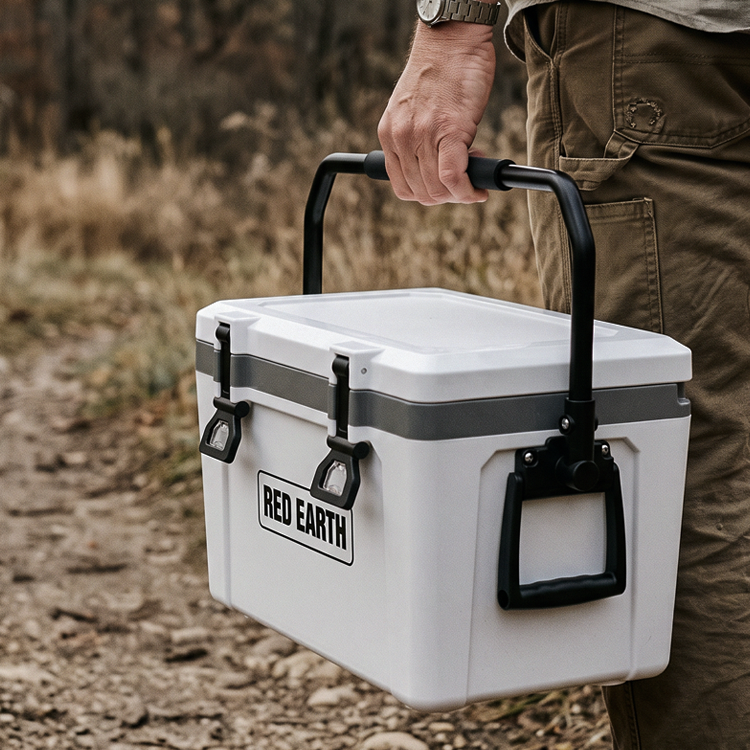
The lid is where most cold escapes. A compression gasket seated in a recessed channel holds the seal under load and vibration, while a flat or worn gasket leaks warm air on every bounce across the deck. Drain design is the second silent factor: a threaded, gasketed drain low on the wall lets meltwater escape without opening the lid, preserving the cold air column. Poorly placed drains force frequent lid lifts, each one trading retained cold for a few seconds of convenience and cutting quoted days noticeably. Food-grade silicone gaskets resist compression set better than cheap rubber, holding the seal through hundreds of lid cycles.
Typical injected coolers hold ice roughly one to two days under summer conditions, adequate for day trips but risky offshore. Rotomolded builds with thick foam and a sound gasket commonly reach three to five days, and premium deep-wall units extend toward a week when paired with block ice and pre-chilling. These ranges are conservative field estimates, not laboratory promises. Buyers should map the target trip length to the lower end of a model's range and keep a safety margin, since ambient heat, lid openings and load practice all erode the headline number. Ambient shade and a pre-frozen unit can add a day, while direct sun on a dark shell can strip two.
Before committing volume on coolers, verify the manufacturer runs an ISO 9001 quality system and uses food-grade, FDA- or LFGB-compliant materials for liners and gaskets. Inspect the lid closure for even compression, confirm the drain seals without tools, and check weld or seam continuity on the shell. Request a small pilot batch and run a real ice-retention test in the destination climate rather than a showroom. Documented thermal performance from an independent check gives importers defensible specs to share with downstream retailers and reduces returns from disappointed end users. Ask for material certificates and a documented production lot trace so any field failure can be traced to a batch rather than guesswork, protecting both importer and end retailer.
Cold chain discipline extends every quoted day. Pre-chill the unit overnight with ice or cold packs, then load frozen block ice beneath the catch with minimal air space. Keep the cooler out of direct sun, open the lid only when necessary, and use the drain to release meltwater without lifting the lid. After the trip, wash with mild soap, dry fully, and store the lid ajar so the gasket does not take a compression set. Simple habits like these protect the insulation and keep a unit performing across many seasons of fishing use. Storing the unit in a cool, dry place between trips prevents mould in the gasket channel and keeps the foam from absorbing moisture that would weaken future thermal performance.
Selecting the right unit starts with the trip, not the catalogue. Multi-day fishing demands coolers rated at the lower end of a realistic range, built with thick foam, a seated compression gasket and a low gasketed drain. Match ice-to-volume ratio and cold-chain habits to the build, verify materials and run a pilot retention test, and the catch stays safe from launch to landing.
What retention day rating should a buyer trust for a four day trip?
Answer: A buyer should plan against the low end of a model's claimed range rather than the headline figure. For a four-day offshore trip, choose units rated five to six days under comparable heat, leaving margin for lid openings and ambient spikes. Request a pilot ice-retention test in the destination climate and compare results to the quoted number. This conservative mapping protects the catch and avoids retailer complaints when real conditions erode the optimistic printed claim.
Why does drain design affect how long ice lasts?
Answer: Unsealed drains force frequent lid openings, each leaking cold and admitting warm air that speeds melting. A low, gasketed drain lets meltwater escape without lifting the lid, so the cold column stays intact and retention days hold. Threaded drains with a seated gasket also stop slow leaks during transit across a vibrating deck. Drain geometry is therefore a quiet but decisive factor in whether a unit meets its quoted ice duration on a real fishing run.
How should block ice be packed for maximum days?
Answer: Pre-chill the empty unit overnight with cold packs or a sacrificial ice bag. Load frozen block ice across the bottom, set the catch above it with minimal air gaps, and top with a thin layer. Keep the ice-to-volume ratio near two to one and avoid loose cubes that melt early. Close the lid firmly and keep the unit shaded. This packing protects the cold column and pushes real retention toward the upper end of the rated window.
Can a thin-walled cooler be improved with extra ice?
Answer: Extra ice helps a thin-walled unit last longer, but it cannot rebuild lost foam or reseal a weak gasket. Coolers with narrow walls still bridge heat fast, so the gain stays modest and the catch risks spoiling by day three. The fix is correct packing, shade, and a pilot retention test before ordering. For true multi-day fishing, specify thicker rotomolded foam and a seated lid gasket instead of relying on extra ice.
Which inspection confirms a gasket will hold offshore?
Answer: Press the lid closed and check for even compression around the full perimeter with no gaps or light leaks. Remove the drain plug and confirm the gasket seats without tools and shows no cracks. Run a pilot ice-retention test in the destination climate and record the day the interior crosses safe temperature. Combine liner certification with this field check to confirm the seal survives deck vibration, salt spray, and repeated lid lifts offshore.

 Hot News